
One Page Business Briefing
The Territory Management Model (S-P-C)
by Greg Lee
THE main business strategy is to build a reliable and increasing income stream, or put simply, to create loyal customers who come back to buy again and again. Ideally these customers would also pay a larger premium over time, as well as give testimonials and allow us to field-test our new products.
Of course loyal customers had to start out as first-time customers when they may have haggled over the price while they built up trust in the business and its products and services. Some of these first-time customers only buy once, or come back infrequently. At best they do not desire any closer form of relationship – either they’re just confirmed hagglers or they have a better relationship with a competitor.
The business strategy should be to build, retain and grow this loyal, premium, re-buying customer base by converting more serious prospects into first-time customers and, then, repeat customers. Retaining these customers involves more than just high customer satisfaction, but also strengthening the relationship between the business and them. This process should also lead to growth through better understanding the customer’s broader needs and better linking the business’s broader capabilities (N+S=B).
To retain customers and create loyalty we need to assess the strength of the relationship (see Customer Relationship Assessment briefing and tools). To build first-time customers, more serious prospects must be created. To create serious prospects more formal face-to-face meetings with suspects are needed, and to create first meetings the business needs initial contacts.
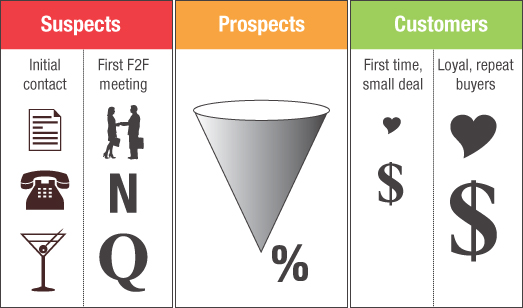
Creating serious prospects should be a combination of quantity and quality to form a growing pipeline of opportunities. How many prospects are needed? To answer this question look at the business’s historical conversion rate from prospect to first-time customer, as well as typical deal size, to calculate the number of prospects required.
It would be easy to focus on quantity alone and put every vague opportunity into our pipeline in building serious prospects, but this just lowers the conversion rate at the other end. In order to focus on quality as well as quantity, qualify suspects on the basis of whether they have a real need, whether the business can address that need, whether that can be done profitably and whether we can win against the competition. In order to assess the winability look at all those who might be involved in the decision to buy, and how they will make their recommendation(s).
How many of these suspects are needed? Again, look at the historical conversion rate from first contact to serious prospect in order to calculate how many initial contacts are required. Consider distinguishing between first contact of any kind, and the first formal meeting, as there can be a conversion rate and time lag between these two as well.

The Territory Management Model (S-P-C)
Download PDF