
One Page Business Briefing
Emotional Quotient (EQ) for Salespeople and Sales Managers
by Greg Lee
THERE used to be only one measure of intelligence – our Intelligence Quota or Quotient (IQ). More recently Howard Gardner (‘Frames of Mind: The Theory of Multiple Intelligences’) tells us there are at least five different forms of ‘intelligence’, including Analytical/Logical, Spatial, Emotional, Musical, and Creative/Innovative. What we used to refer to as ‘intelligence’ is really now just analytical or left-brain intelligence.
It may well be an important pre-requisite in job roles such as engineering, but in other roles such as Customer Service or Nursing/Aged Care, Emotional intelligence or people-handling skills, may be much more important than logic and analysis. Of course, all forms of intelligence come naturally for some and not for others, and fortunately they can all be taught to some extent – particularly given the recent understanding of neuroplasticity.
What is the Emotional Quotient (EQ)?
For many, EQ means the ability to read others, to pick up on their conscious and unconscious cues. For others it is the care for and interest in others. These two things are not the same but may well go together to form high EQ, along with good questioning and listening skills. These latter two skills comprise the ‘how to’ of EQ, underpinned by the requisite cognitive skills (the way our brain is wired) such as Orientation and Rule Induction.I define EQ as:
EQ = Cognitive + Communications + Empathy + Optimism and Resilience.
What is the role of EQ in Sales?
In the old days, for many people, sales was a matter of chasing a quota or target by making as many one-off sales as possible. This approach degenerated into “feature flogging” and using the 53 Closing Techniques to close often, early and hard. This approach has been supplanted with a more consultative approach which aims for repeat buying and loyalty – even in the consumer retail space – so EQ is a much more important pre-requisite for 21st Century sales roles.
What is the role of EQ in Leadership and Sales Management?
Even in military and manufacturing operational roles, leaders cannot afford to always shout “do as I say” lest their followers eventually don’t wish to follow any more. Nor is it appropriate for leaders to try to be a “nice guy” and everybody’s “mate”. Leaders need to be optimists in order to create and recreate the vision and keep their team focussed and motivated. They also need to be strong role models by identifying and managing their own negative emotions and self-doubts.
What should Sales Managers do about EQ?
Given that Sales Managers are in both sales and leadership, it is vital that they are aware of their own EQ as well as that of their salespeople. They should check their own inherent levels of optimism and resilience by completing the SASQ test (Seligman Attributional Style Questionnaire). They should also use this same test to check their current and particularly future salespeople.
Sales Managers should also check their own levels of the broader EQ including empathy using the TEIQ, SCEIT, or EQ360/ EQI tests … and then seek coaching if they really want to be the best possible leaders and role models. If their salespeople are required to focus on long-term customer relationships then they, too, should be checked for their broader empathy-based EQ.
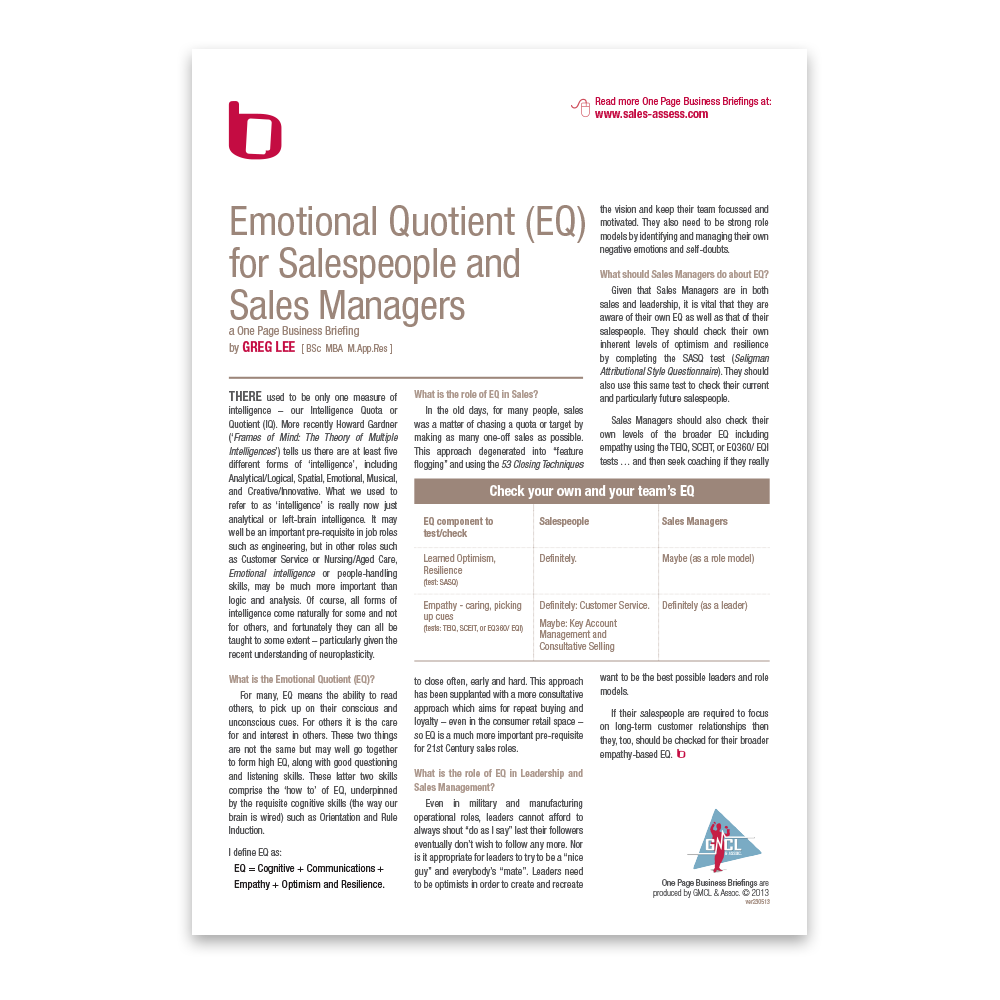
Emotional quotient (EQ) for salespeople and sales managers
Download PDF