One Page Business Briefing
Thought Leadership and Strategic Thinking
by Greg Lee
“Congratulations on your promotion. You’ll need to think more strategically now.”
So said a very senior banker recently to one of my executive coaching clients. When she replied “Thank you very much, and where do I go to learn to think more strategically?”, he was not able to provide a reference, a link or url, a book, or a training course. And before we go any further, there is no science that suggests men are automatically better at strategic thinking than women.
Monty Python fans may well say “Tell us, Lord, how shall we think more strategically?”
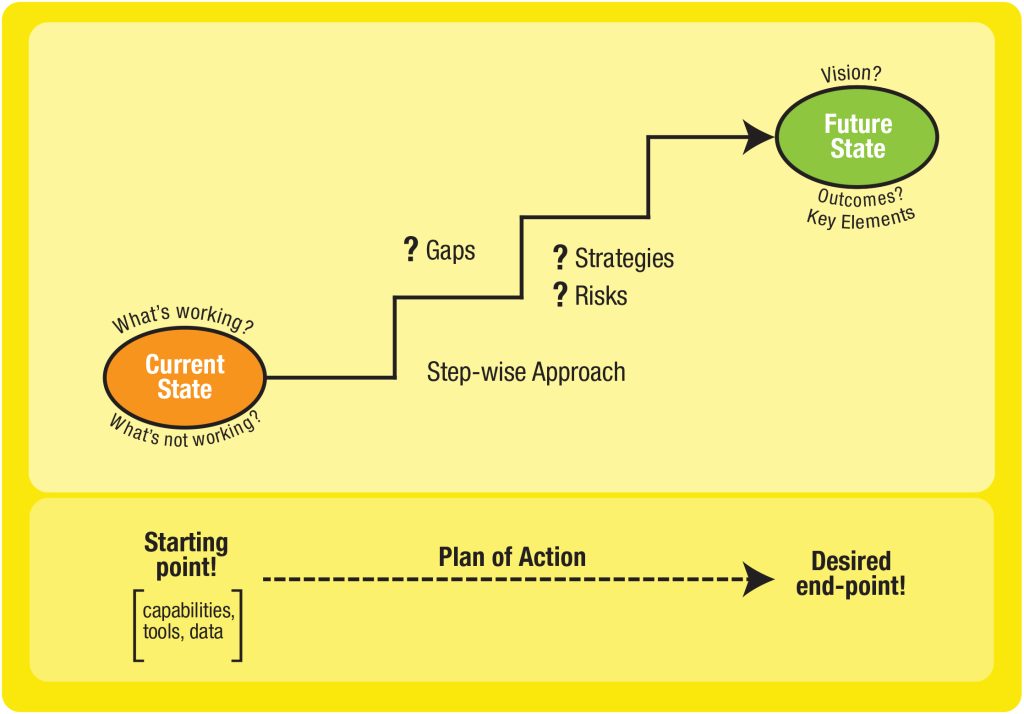
Well, it involves analysing the starting point, the Current State, to consider what’s working and what’s not. We then consider the Future State – where would we like to be and how we would like it to look. Having done that, we can guage the gap and develop strategies to get us from here to there.
Anglo Saxons are relatively less effective at strategic thinking than most other cultures, so if our brains are hard-wired we would be at considerable disadvantage. Fortunately, we now know about neuroplasticity (from Dr. Norman Doidge) and understand that the brain can be re-wired and strengthened and is not a physiologically static organ.
I have been coaching cognitive development now for several years and this thinking formed the basis of a recent workshop that I ran with the management team of a fast-growing Australian software company. They were looking to develop technicians who had been promoted from technical and operational roles into team leader and regional manager roles. The company wanted them to see the bigger picture, think more laterally, make better decisions, and lead from ‘The Bridge’ rather than diving back down into the engine room to solve problems themselves.
We grouped strategic thinking, innovative thinking and critical thinking under the broader heading of Thought Leadership and gave them games and exercises to expand their cognitive capabilities. We then applied these techniques to a case study based on their own company and to capabilities such as analysing data, brainstorming future options, and stress-testing those options. We also investigated personalities using various models to provide insight into how to communicate and work with different kinds of people in these different forms of workplace activity.
Strategic Thinking, for example, requires intuitives and expressives to come up with new ideas and to sell the vision, while analyticals and thinkers are required to scrutinise what’s working and what’s not, and to stress-test strategic options for getting from here to there. Feelers and amiables are required for emotional intelligence and engagement, whilst drivers and judgers are required to distill strategies into executable plans of action.
Rest assured, people can learn how to think more strategically. It can be tough. It can be fun. And it can be maintained in all kinds of ways – building kids’ cubby-houses, playing a musical instrument, performing arts and crafts, even by cooking … though you need to develop your plans yourself rather than slavishly following the instructions.
Thought Leadership in the form of strategic, innovative, and critical thinking can and should be developed to enable better leadership at all levels in organisations and provide greater staff engagement and productivity.

Thought leadership and strategic thinking
Download PDF